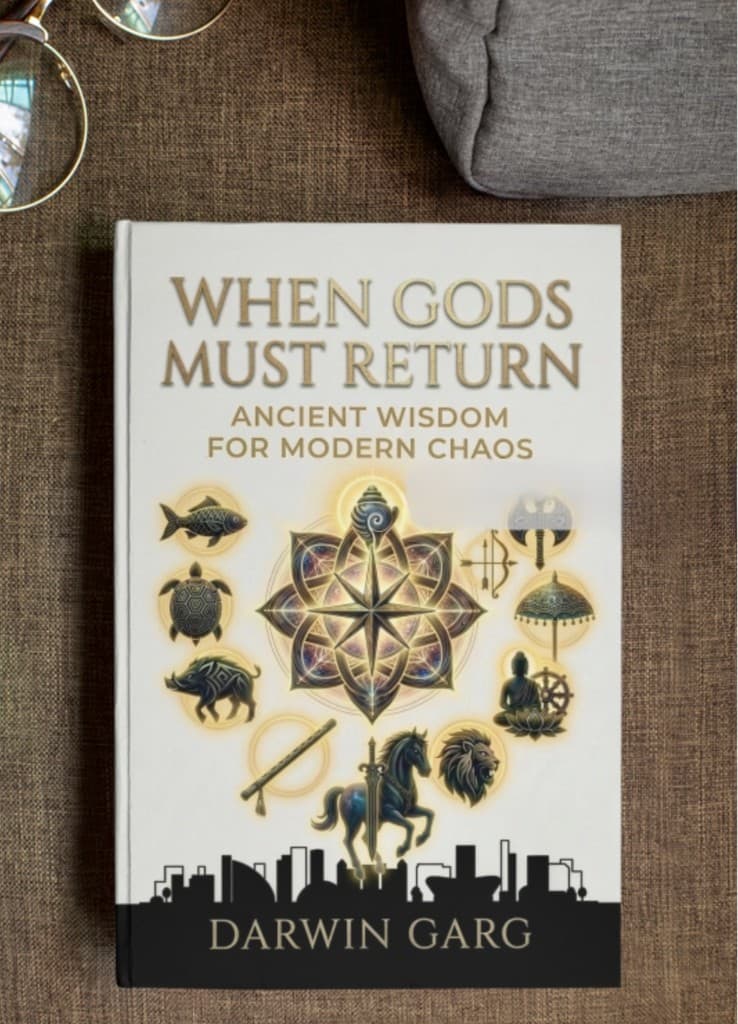
I did not begin with the Dashavatar. I began with a restlessness I could not name — the feeling that the stories I had grown up with were not obsolete, but unfinished. They were waiting for a world loud enough to need them again.
When stories become maps
The turning point came quietly. I was not in a temple or a library. I was in the middle of an ordinary week — notifications, headlines, a meeting that ran long — when the pattern clicked. Each avatar in the tradition arrives when the world has tipped too far in one direction. Not to repeat the old order, but to restore a balance the age has lost.
Matsya is not a metaphor for heroism. It is navigation in a flood. Kurma is not patience as personality. It is the slow work of holding weight while the churning continues. Once I saw that, I could not unsee it. The avatars were never ten versions of the same lesson. They were ten forms of attention.
“The book had to hold all ten at once — because our age refuses to arrive one crisis at a time.”
From the author's notes
Why the framework had to stay whole
There were moments in the writing when a single avatar would have made the project easier to market, easier to summarise, easier to defend. One crisis. One wisdom. One clean promise. I resisted that temptation because it would have betrayed the reader's actual life.
The framework found me because I needed a way to write about complexity without turning complexity into an excuse for vagueness. Ten avatars. Ten crises. One book — not to solve everything, but to restore the dignity of seeing clearly.