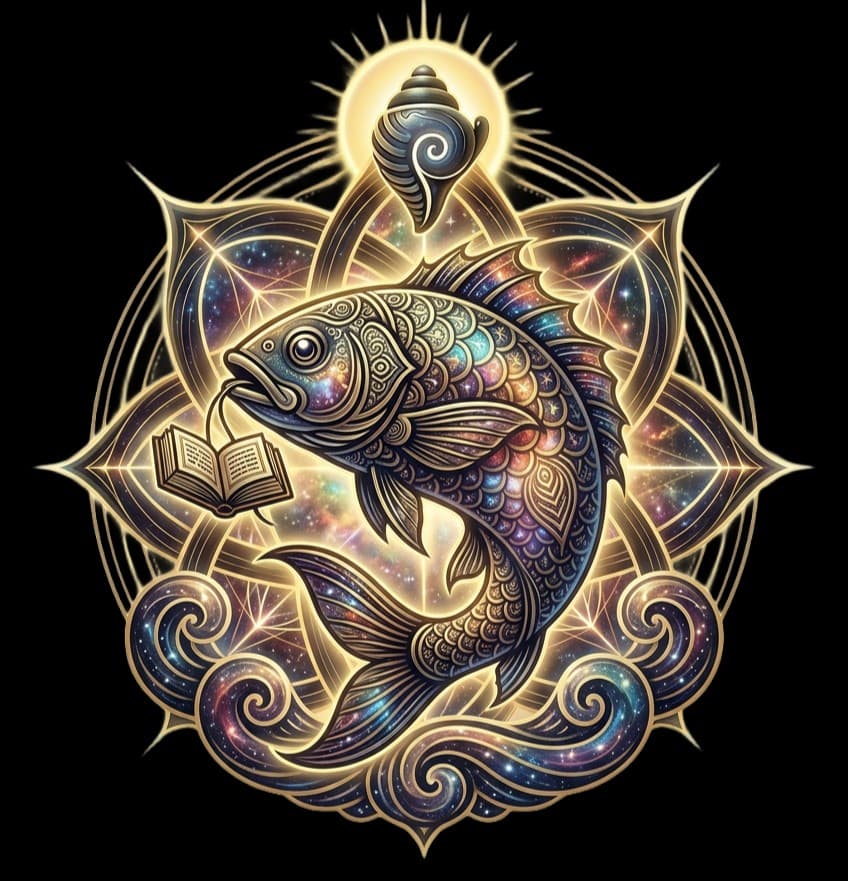
The first avatar arrives as a fish — small, easy to miss, absurd to trust. That is the point. When the flood comes, salvation does not always enter the story with thunder. Sometimes it arrives as orientation.
Every screen is a storm
We call it misinformation, but the older word is flood. Too much. Too fast. Too many voices claiming the center. The problem is not only falsehood. It is volume — the sheer quantity of signal that makes discernment feel like a luxury we cannot afford.
Matsya does not teach us to win the argument. The tradition is wiser than that. It teaches navigation: how to move when the landmarks disappear, how to preserve what must survive the deluge, how to trust the small voice that knows the direction when the horizon is gone.
“Discernment is a collective act, not a solo virtue.”
What the first wisdom asks of us
- Slow down before you share — speed is often the flood's ally.
- Protect primary trust — family, friendship, local truth-telling.
- Seek guides, not gurus — orientation beats certainty.
- Preserve the seed — some knowledge must survive the noise.
In the book, Matsya meets the modern world not as a mascot for virtue-signalling, but as a pressure on attention itself. The first crisis is not out there alone. It prepares the ground for every other crisis that follows.
If our age feels disorienting, perhaps it is not because we lack opinions. Perhaps it is because we have forgotten how to navigate together while the water rises.