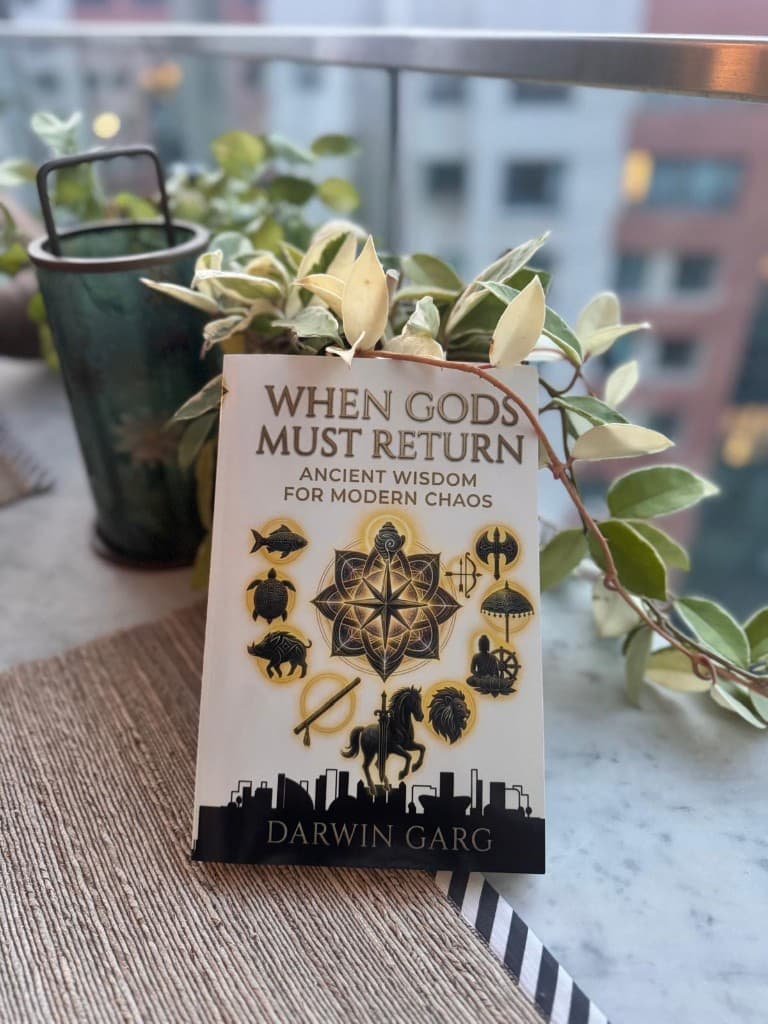
We have been trained to look for the one big answer. The framework. The leader. The book that explains everything in a single sweep. It is a comforting habit — and a dangerous one.
Look around and the pattern is unmistakable. Misinformation does not arrive alone. It travels with loneliness, with economic anxiety, with the slow burn of climate dread. Mental health collapses do not happen in a vacuum; they rise alongside the collapse of trust. Power concentrates while institutions fray. None of these crises waits politely for the others to finish.
Ten crises, one age
When I began writing When Gods Must Return, I did not set out to find ten problems. I set out to understand why the ancient Dashavatar — the ten avatars of Vishnu — had never felt like mere mythology to me. Each form arrives when the world has tipped too far in one direction. Each carries a particular kind of wisdom, not a universal solvent.
Matsya does not solve what Narasimha solves. Krishna does not replace Kalki. The tradition never pretended otherwise. It offered something harder and more honest: a map for complexity.
What we need isn't one answer. We need ten — working together.
Why one wisdom fails
A single ideology always overreaches. It takes a partial truth — discipline, compassion, reason, faith — and asks it to carry the full weight of a civilisation. Eventually it cracks. The crack is not a failure of the idea. It is a failure of scale.
- When we treat technology as salvation, we forget the human cost of speed.
- When we treat tradition as complete, we forget the world it was built for has changed.
- When we treat outrage as clarity, we forget that discernment is slower and more necessary than ever.
Our age does not suffer from a shortage of opinions. It suffers from a shortage of integrated wisdom — the kind that can hold contradiction without collapsing into cynicism.
The work of ten
Ten wisdoms is not ten times the noise. It is ten forms of attention. Navigation when the flood rises. Courage when power hides inside civility. Restraint when appetite masquerades as freedom. Each avatar, in the book, meets an ordinary person facing an ordinary Tuesday that has become impossible.
That was the test I set for myself as a writer: not to preach ten lessons, but to show ten ways of seeing. If the book works, it is not because it solves everything. It is because it refuses the lie that one thing alone ever could.
The gods return not when we are ready for a single revelation, but when we are humble enough to need many.
From the author's notes
What comes next
This essay is an invitation — to read slowly, to hold more than one frame at a time, to notice which crisis in your own life is asking for which kind of wisdom. The journey does not begin with agreement. It begins with attention.
If that sounds like the world you are already living in, then this book was written for you.